
BIGBEAR
PHARMACEUTICAL
Precise targeting, striking the core pathway directlyGold combination, breaking through the drug resistance bottleneckOral convenience, elevating the quality of life.

 AuthenticGuaranteeFast DeliveryPrivacy
 This indication is granted conditional approval based on the objective response rate and duration of response data from a Phase II clinical trial. The full approval of this indication is contingent upon the confirmatory clinical trial currently underway verifying the clinical benefit of Trametinib Tablets in combination with Dabrafenib Mesylate Capsules.
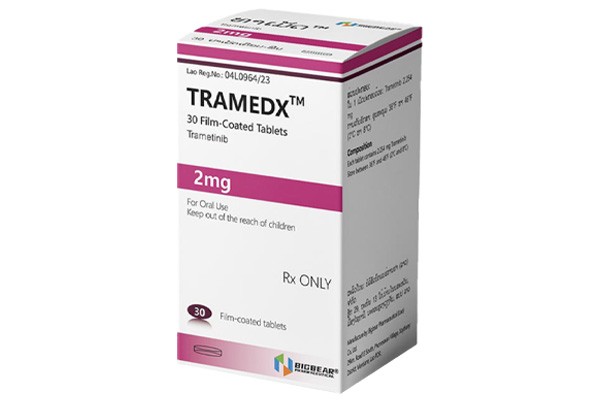
This product, in combination with dabrafenib mesylate, is indicated for the treatment of patients with BRAF V600 mutation-positive unresectable or metastatic melanoma.
This product, in combination with dabrafenib mesylate, is indicated for the adjuvant treatment of patients with completely resected Stage III BRAF V600 mutation-positive melanoma.
This product, in combination with dabrafenib mesylate, is indicated for the treatment of patients with BRAF V600 mutation-positive metastatic non-small cell lung cancer.
The recommended dose of this product is 2 mg orally once daily, in combination with dabrafenib mesylate, until disease progression or intolerable toxicity occurs.
This product should be taken at least 1 hour before or at least 2 hours after a meal. It should be taken at the same time each day.
If a dose of this product is missed, it should be taken no later than 12 hours before the next scheduled dose. If less than 12 hours remain until the next scheduled dose, the missed dose should not be taken.
When used in combination with dabrafenib mesylate, this product should be taken once daily at the same time each day, together with dabrafenib mesylate administered in the morning or evening. This product should not be chewed or crushed.
No dosage adjustment is required for patients with mild hepatic impairment. No clinical data are available for patients with moderate or severe hepatic impairment; therefore, the potential need for initial dosage adjustment cannot be determined. This product should be used with caution in patients with moderate or severe hepatic impairment.
No dosage adjustment is required for patients with mild or moderate renal impairment. No clinical data are available for patients with severe renal impairment; therefore, the potential need for initial dosage adjustment cannot be determined. This product should be used with caution in patients with severe renal impairment.
The safety and efficacy of this product have not been established in pediatric and adolescent patients (<18 years of age). No data are available.
No initial dosage adjustment is required for patients aged 65 years and older. However, dosage adjustments may need to be made more frequently in patients aged 65 years and older.
Since clinical trials are conducted under a variety of conditions, the incidence of adverse reactions observed in the clinical trials of one drug cannot be directly compared with that observed in the clinical trials of another drug, nor does it necessarily reflect the incidence observed in clinical practice.
The safety of this product was evaluated in the METRIC study, a randomized, open-label trial conducted in patients with BRAF V600E or V600K mutation-positive unresectable or metastatic melanoma. Patients received either oral trametinib 2 mg once daily (N=211) or chemotherapy (N=99) (dacarbazine 1000 mg/m² every 3 weeks or paclitaxel 175 mg/m² every 3 weeks). Patients with LVEF abnormalities, a history of acute coronary syndrome within the past 6 months, or current Class II or higher congestive heart failure (New York Heart Association) were excluded. The median duration of treatment with this product was 4.3 months.
In this study, adverse reactions leading to permanent discontinuation of the trial drug occurred in 9% of patients treated with this product.
The most common adverse reactions resulting in permanent discontinuation of this product were decreased left ventricular ejection fraction (LVEF), pneumonitis, renal failure, diarrhea, and rash. Adverse reactions leading to dose reductions occurred in 27% of patients treated with this product. The most frequent reasons for dose reductions of this product were rash and decreased LVEF.
This product is contraindicated in patients with hypersensitivity to the active substance or any of the excipients.
Limited data are available on the use of this product in combination with dabrafenib mesylate for patients who have experienced disease progression following prior BRAF inhibitor therapy, but these data indicate that the efficacy of the combination therapy is lower in such patients.Therefore, for patients with prior BRAF inhibitor therapy, alternative treatment options should be considered first before administering the combination therapy. The optimal treatment sequence after disease progression on BRAF inhibitor therapy has not been established.
In clinical trials of this product in combination with dabrafenib mesylate, 2% of patients developed cutaneous squamous cell carcinoma (cuSCC) and keratoacanthoma. Basal cell carcinoma and new primary melanoma occurred in 3% and <1% of patients, respectively.A dermatological evaluation should be performed prior to the initiation of combination therapy with this product and dabrafenib mesylate, repeated every 2 months during treatment, and once more within 6 months after discontinuation of the combination therapy.
Based on its mechanism of action, dabrafenib mesylate can activate RAS through mutation or other mechanisms, promoting malignant tumor growth and progression; see the prescribing information for Dabrafenib Mesylate Capsules. In clinical trials of this product in combination with dabrafenib mesylate, 1% of patients developed non-cutaneous malignancies.Monitor patients receiving this product in combination with dabrafenib mesylate for signs or symptoms of non-cutaneous malignancies. No dosage adjustment of this product is required for patients who develop non-cutaneous malignancies.
Bleeding events, including major bleeding (defined as symptomatic bleeding in a critical site or organ), may occur in patients taking this product. Fatal cases have been reported.In clinical trials of this product in combination with dabrafenib mesylate, 17% of patients experienced bleeding events. Gastrointestinal bleeding occurred in 3% of patients receiving the combination therapy, intracranial bleeding in 0.6%, and fatal bleeding in 0.5%. Fatal events were cerebral hemorrhage and brain stem hemorrhage.Permanently discontinue this product for all grade 4 bleeding events and any grade 3 bleeding events that do not resolve. For grade 3 bleeding events, interrupt dosing of this product; resume at the next lower dose level if the event resolves.
Colitis and gastrointestinal perforation, including fatal outcomes, have been reported in patients receiving this product as monotherapy and in combination with dabrafenib mesylate. <1% of patients developed colitis and <1% developed gastrointestinal perforation in clinical trials of this product as monotherapy. <1% of patients developed colitis and <1% developed gastrointestinal perforation in clinical trials of the combination therapy.Closely monitor patients for signs and symptoms of colitis and gastrointestinal perforation.
In clinical trials of this product in combination with dabrafenib mesylate, 2% of patients developed deep venous thromboembolism (DVT) and pulmonary embolism (PE).Inform patients to seek immediate medical attention if they experience symptoms of DVT or PE (e.g., shortness of breath, chest pain, swelling of the arms or legs). Permanently discontinue this product for life-threatening PE. For uncomplicated DVT and PE, interrupt dosing of this product for up to 3 weeks; resume at a lower dose level if the event resolves.
Cardiomyopathy, including heart failure, may occur in patients taking this product.In clinical trials of this product in combination with dabrafenib mesylate, 6% of patients developed cardiomyopathy, defined as a ≥10% decrease in left ventricular ejection fraction (LVEF) from baseline and a value below the institutional lower limit of normal (LLN). Cardiomyopathy led to dose interruption or discontinuation of this product in 3% and <1% of patients, respectively. Cardiomyopathy resolved in 45 of 50 patients receiving the combination therapy.Assess LVEF by echocardiogram or multigated acquisition (MUGA) scan prior to the initiation of this product as monotherapy or combination therapy, 1 month after treatment initiation, and approximately every 3 months during treatment. For asymptomatic LVEF decrease of ≥10% absolute from baseline and below LLN, interrupt dosing of this product for up to 4 weeks. Resume at a lower dose if LVEF returns to normal. Permanently discontinue this product if LVEF does not return to normal within 4 weeks. Permanently discontinue this product for symptomatic cardiomyopathy or an absolute decrease in LVEF of >20% from baseline and below LLN.
The incidence of RVO was 0.6% in clinical trials of this product as monotherapy. No cases of RVO were reported in clinical trials of the combination therapy. RVO may lead to macular edema, decreased visual acuity, neovascularization, and glaucoma.Perform an ophthalmologic evaluation as soon as possible (within 24 hours) for patients reporting vision loss or other visual disturbances. Permanently discontinue this product in patients with RVO.
RPED may occur in patients taking this product. Detachments can be bilateral and multifocal, and may occur in the central macular area or other parts of the retina. Routine monitoring for asymptomatic RPED was not performed in melanoma and non-small cell lung cancer trials; therefore, the true incidence of this finding is unknown.Perform regular ophthalmologic evaluations and additional evaluations if patients report visual disturbances. Interrupt dosing of this product if RPED is diagnosed. Resume treatment with this product at the same or a lower dose if repeat ophthalmologic evaluation shows resolution of RPED within 3 weeks. If RPED does not resolve within 3 weeks, resume at a lower dose or permanently discontinue this product.
Interstitial lung disease (ILD) or pneumonitis occurred in 2% of patients in clinical trials of this product as monotherapy and 1% of patients in clinical trials of the combination therapy.Interrupt dosing of this product in patients with new or progressive pulmonary symptoms and other signs (including cough, dyspnea, hypoxia, pleural effusion, or infiltrates) and await clinical evaluation. Permanently discontinue this product in patients diagnosed with treatment-related ILD or pneumonitis.
Severe febrile reactions and fever of any severity associated with hypotension, chills or rigors, dehydration, or renal failure may occur in patients receiving this product in combination with dabrafenib mesylate.In clinical trials of the combination therapy, 58% of patients developed fever. Severe febrile reactions and fever of any severity with hypotension, chills or rigors, dehydration, or renal failure occurred in 5% of patients. Fever with hypotension occurred in 4%, with dehydration in 3%, with syncope in 2%, with renal failure in 1%, and with severe chills/rigors in <1% of patients.Withhold this product for a temperature ≥38°C when used as monotherapy, and withhold both this product and dabrafenib mesylate when used in combination. Treatment interruption may also be initiated at the first sign of fever if recurrence occurs. Fever may be complicated by hypotension, chills or rigors, dehydration, or renal failure. Evaluate for signs and symptoms of infection and monitor serum creatinine and other renal function parameters during and after severe fever. Resume treatment with this product as monotherapy or in combination with dabrafenib mesylate at the same or a lower dose, if applicable, once the patient's symptoms have resolved for at least 24 hours.Administer antipyretics prophylactically as adjunctive therapy when resuming this product in patients with a history of severe febrile reactions or fever with complications. For a second or subsequent episode of fever, if fever does not return to baseline within 3 days or is associated with fever-related complications (e.g., dehydration, hypotension, renal failure, or severe chills/rigors) in the absence of active infection, administer corticosteroids (e.g., prednisone 10 mg daily) for at least 5 days.
Severe cutaneous adverse reactions (SCARs), including Stevens-Johnson syndrome (SJS) and drug reaction with eosinophilia and systemic symptoms (DRESS), which may be life-threatening or fatal, have been reported during treatment with dabrafenib mesylate in combination with this product.Other severe cutaneous toxicities occurred in <1% of patients in clinical trials of the combination therapy. Monitor for new or worsening severe cutaneous reactions; permanently discontinue this product if SCARs occur. Interrupt dosing of this product for other cutaneous toxicities. Resume treatment with this product at a lower dose if the cutaneous toxicity improves or resolves within 3 weeks. Permanently discontinue this product if the cutaneous toxicity does not improve within 3 weeks.
In clinical trials of this product in combination with dabrafenib mesylate, 15% of diabetic patients required more intensive antidiabetic therapy. Grade 3 and 4 hyperglycemia occurred in 2% of patients.Monitor blood glucose levels in patients with a history of diabetes or hyperglycemia at the initiation of treatment with this product in combination with dabrafenib mesylate and as clinically indicated. Initiate or optimize antidiabetic medications based on clinical signs.
This product is indicated for use in combination with dabrafenib mesylate. Prior to the initiation of combination therapy, review the prescribing information for Dabrafenib Mesylate Capsules for information on the serious risks of dabrafenib mesylate.
Inform females of reproductive potential that animal studies have shown that trametinib can cause harm to fetal development. Advise sexually active females of reproductive potential to use effective contraception (methods resulting in a pregnancy rate of <1%) during treatment with this product and for at least 16 weeks after the last dose. Inform females of reproductive potential receiving this product in combination with dabrafenib mesylate that dabrafenib mesylate may reduce the efficacy of oral or any other systemic hormonal contraceptives, and an effective alternative contraceptive method should be used.
This product has a minor effect on the ability to drive and operate machinery. When considering a patient's ability to perform tasks requiring judgment, motor, and cognitive skills, attention should be paid to the patient's clinical condition and adverse reaction profile. Patients should be advised that fatigue, dizziness, or ocular problems that may occur could affect their ability to perform such tasks.
The potential effect of trametinib on prolongation of the corrected QT (QTc) interval was evaluated in a dedicated study of 32 patients (who received placebo on day 1, 2 mg of this product once daily on days 2-14, and 3 mg of this product on day 15). No clinically meaningful QTc prolongation was detected in this study.In clinical trials of patients receiving this product in combination with dabrafenib mesylate, 0.8% of patients had a QTc prolongation >500 ms, and 3.8% had an increase in QTc >60 ms from baseline.
If any issues arise, please contact us immediately.
Email:laosbigbear@gmail.com

Copyright2024@ BIGBEAR All right reserved Bigbear | Bigbear Pharmaceutical | Bigbear Laos


